

We all have a to do list and a transition isn’t just a moment of switching from one job to the next. It’s a process. It involves stopping and leaving one thing, navigating the space in between, and then starting something else with intention.
Most of us can drive and talk at the same time. We can walk and listen while we eat lunch, listen to music, and read a book at the same time. However, our brains CAN’T do more than one complicated, complex, or novel task at a time
A transition can be moving from any desired activity (sleeping) to a less desirable activity (getting ready for work).
Every time you switch tasks, your brain needs to perform 4 different tasks (executive functions):
- Stop/ Inhibit (pulling yourself away)
- Switch (moving over to the next task)
- Start (getting going on the new task)
- Focus (zeroing in on that new task)
The ADHD brain is characterised by differences in brain structure and function, particularly in regions responsible for executive functioning, such as the frontal lobe
Therefore task switching for people with ADHD feels incredibly dysregulating.
Why?
- The brains “on/off” switches of someone with ADHD tend not to be as efficient as those found in non-ADHD brains.
- This means we might take longer than others when needing to shift attention between different activities or responsibilities.
- It is harder for us to hold multiple pieces of information in our minds while trying to switch focus from one task to another.
- Task switching can be challenging is our increased distractibility.
- Our ADHD brains are more likely to feel foggy, be impulsive, feel unable to start, feel unable to stop, interrupt, get angry and frustrated, and generally feel more out of control.
- When the ADHD brain is in hyper-focus, it’s “all-on”- it’s absorbed, focused, and when the ADHD brain is in this zone, it can feel almost impossible to move away!
- The ADHD brain’s natural desire is to seek out new tasks, switch focus, and “multi-task,”.
The Neuroscience of Task Transitions
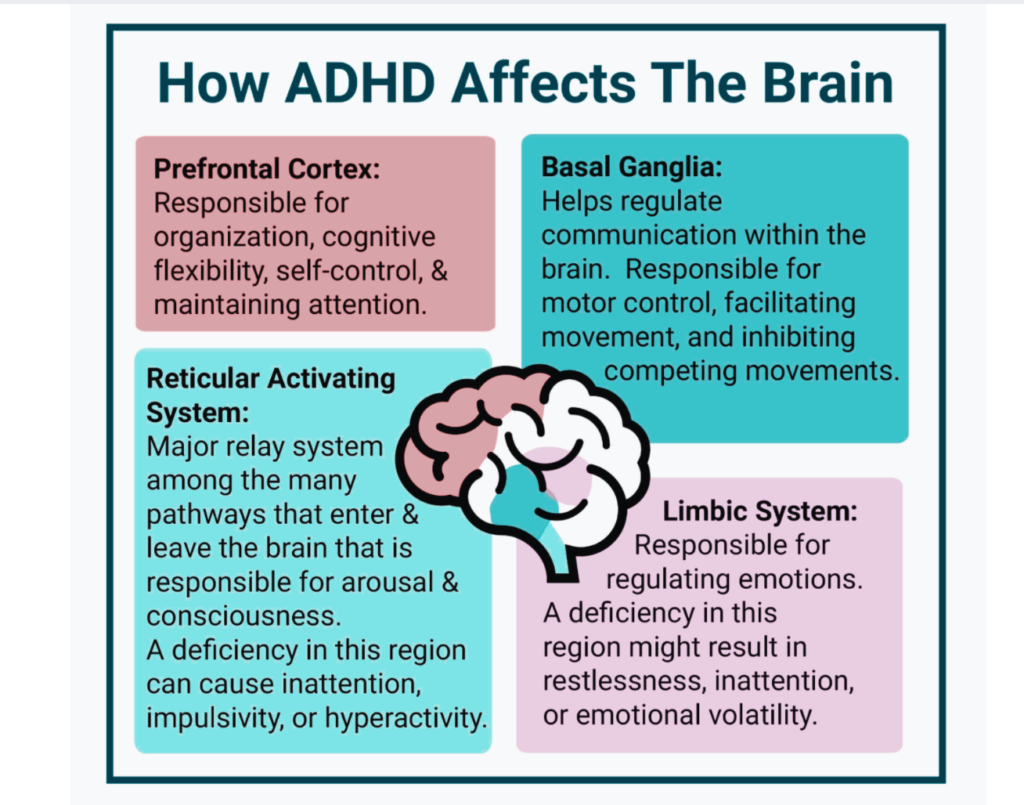
The frontal lobe, limbic system, RAS and basal ganglia are all impacted negatively, leading to deficiencies in self-control and decision making. This can lead to an inability or resistance to decide on priorities and maintain or begin working.
How it makes us feel
It’s frustrating and can make us feel uncomfortable and angry.
Then we usually feel guilty about not producing our best work.
When our brains are struggling to manage the transitions of daily life, it can be useful to identify where on the path of transition it is getting stuck: Stopping—-Switching—-Starting—-Focusing.

That might sound simple, but for ADHD adults, each of those steps can be a struggle.
Transitions are more difficult for those of us with ADHD because of challenges with shifting attention, changing routines, and emotional dysregulation. tasks
Why transitions are harder with ADHD
- Difficulty with shifting attention: It’s challenging to switch focus from one activity to another, especially when moving away from something highly engaging.
- Reliance on routine: Individuals with ADHD often depend on routines for structure. Disrupting these routines can be overwhelming and lead to forgetfulness.
- Emotional dysregulation: The anxiety or overwhelm associated with changes can trigger intense emotional reactions, even for minor issues.
- Increased cognitive load: Transitions require conscious effort, which can lead to increased stress and a higher cognitive load, especially for a brain that already struggles with executive function.
Transitions aren’t just about starting or stopping. They’re about moving through each stage with awareness and intention.
Where do we start?
By breaking it into parts — stopping what you’re doing, navigating the in-between, and making it easier to start again — you give yourself more room to succeed.
Create a Clear Plan for Your Day
One way to improve your task switching is by planning ahead and creating a clear plan for your day. Break down tasks into smaller, achievable steps and assign a time limit or deadline to complete each step.
This will help you stay organised and focused while completing those tasks because you’ll know exactly what needs to be done and when.
Try arranging the plan around something pleasurable so that when tasks become tedious or difficult, your focus can be broken up with an activity that you enjoy. This will help create a more manageable system for completing tasks and transitioning between them.
Tackle High-Priority Tasks First: Do the most important tasks when you’re most alert and focused. This might mean front-loading your workday if mornings are your prime time.
Stopping a task you are doing
Stopping a task can feel nearly impossible, especially when it’s interesting or stimulating.
If you’re deep into a task, especially one that’s interesting or stimulating, stopping can feel impossible. You might tell yourself you’ll stop at a specific time. You may even set an alarm.
Then you end up blowing through it. When the alarm goes off, you tell yourself, “I’ll just do this one last thing. It’ll just take 2 minutes.” Then, an hour later, after that “one more thing,” you’re still going.
This can impact everything from daily tasks to major life changes like starting school or moving to adult services. Strategies like using timers, creating structured routines, providing advance notice, and offering choices can help manage these challenges.
Know what you are doing next
If you don’t know what you’re moving on to, there may be no reason to stop. Even a loose daily structure with a few anchor points can help you shift tasks more easily. So you know what you intend to do.
Create a hard stop!
When stopping is especially difficult, having an external trigger can help you to transition, such as scheduling a meeting, appointment, or co-working session immediately after something you know is typically hard for you to pull away from. So you have a natural reason to stop.
Ten minutes before you want to stop, set a loud auditory alert, not a soft ping, but something you can’t ignore. Then use a second alert at your actual stop time.
Get up and move
Physically standing up and moving helps break the connection to the task you’re trying to stop. It tells your brain, “We’re doing something different now.” After that, it may help to work in a different location, even just a new table or chair.
Leave a list of notes of where you were up to
When you finish a work session, set yourself up for an easier start next time. Leave notes about where you left off or what your first step will be.
Close the task
Fully close what you’re doing, tabs, documents, even the physical space. So you’re not halfway in both worlds. That can make it easier to shift cleanly to what’s next.
Distracted Between Tasks – The VOID or mid transition
This in-between space can feel like a void when you are not finished with one thing, but not yet started on the next.
The space in between tasks is often where transitions can break down. ADHD makes you more sensitive to distractions.
Because that zone is often invisible or unacknowledged, it’s easy to underestimate how much effort it takes to move through it.
You might be heading toward your desk and stop to put away laundry. Or you plan to start a report after a break, but decide to answer just one email, and suddenly you’re deep in your inbox.
This in-between space is fragile. Without support, it’s easy to get pulled into something easier, more rewarding, or simply more immediate. Because, well, you are prone to distractions, right?
These strategies can help you stay connected to your intention to move to your next task.
Pause
Before jumping to whatever grabs your attention in between tasks, take a moment to reset. Ask yourself: “What did I intend to do?”
How long have I got
Think realistically how long you have got, can you have a tea break? Have you got time for a walk?
Remind yourself why it matters.
Whether saying it aloud or writing it down, naming the reason/reward behind the task
Take care of your bodily needs
Get a cuppa, go to the loo, have a snack or lunch so you are comfortable for the next task.
Moving to the next Task
Even when you’ve stopped one activity and managed not to get sidetracked, getting started on the next task can still feel like a huge effort. You might sit down with the best of intentions, then find yourself hesitating, pacing, or deciding to check something “for a minute.”
Your brain may treat it like a threat and point you toward anything else than that task.
Say it aloud or to yourself
Sometimes repeating the task name, either silently or out loud as you are moving toward the task, can help anchor your attention. ‘Accounts, accounts accounts’.
Make it more interesting
Move chairs, put on some music, have a drink nearby
Prepare to start
Often, for ADHD adults, there’s a rush to do the thing. And the prep work to make the process easier can feel like wasted time. But then, without the prep work, well, you may end up wasting time.
Taking a few minutes to make sure you have everything you need involves setting up the necessary conditions before you begin, such as having all the information at hand.
Sit with the task when it’s uncomfortable
Sometimes the most challenging part is the discomfort of starting. You don’t need to jump right in. Just don’t fill that gap with something else.
Give yourself a pause, be with the discomfort. You could set the timer for 5 minutes. If you still don’t want to start the next task you intend to do, you can move on to something else.
Break it down
If it’s too big for what you’ve got available, shrink it until you can start right away.
More tips for managing transitions
Change the Environment
- When attempting to improve task switching, changing the environment may be beneficial. Putting yourself in a new physical space entirely can be helpful, but by this suggestion, know that there are other, smaller steps you can take as well.
- Maintain a well-balanced diet that includes omega-3 fatty acids, Vitamin B6, Vitamin D, and magnesium can support better task switching for those with ADHD, as proper nutrition plays a crucial role in managing symptoms.
- Use timers: Set alarms or timers to signal when a transition is approaching or when a break is over. This provides a clear, external cue.
- Create transition rituals: Develop a specific, repeatable action to perform when shifting between tasks or activities. This can help build a new, intentional habit.
- Provide advance notice: Give plenty of warning before a transition occurs, especially for children. For example, provide a 15-minute warning before bedtime rather than just saying “it’s time for bed”.
- Offer choices: When possible, provide choices to give a sense of control. For example, ask, “Do you want to get a shower or start chores first?”
- Establish structure: Build new routines and structures to replace old ones. When moving between settings, identify what structures are being lost and create new ones to fill the gap.
- Expectations: Clearly define what the expectations are.
- Use visual aids: Visual aids like calendars, checklists, or visual timers can make the structure of a transition more concrete and easier to follow.
- Embrace self-compassion: Understand that transitions are hard for everyone, and especially for those with ADHD. Be patient with yourself and focus on building strategies rather than getting discouraged.