

 By admin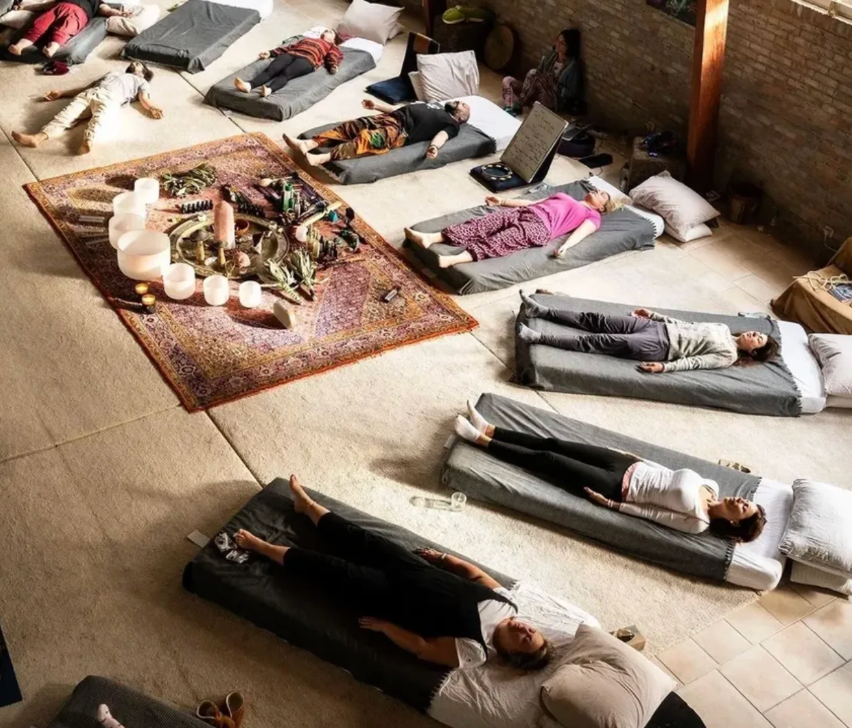
Shortly after writing the first draft of my introduction to psychedelics, I travelled to the Netherlands.

I was not travelling as a tourist.
I was travelling with twenty-one other nurses, psychiatrists, psychologists and therapists to undertake an intensive psychedelic facilitator training course. The Netherlands has a long history of regulated psychedelic-assisted approaches, although the legal position differs according to the substance, setting and type of practice. Our course was an educational experience rather than a clinical trial.
It felt like a significant step.
Until then, I had been reading about psychedelics, learning about the science, the history, the risks and the possibilities. I had been trying to understand them through the lens I knew best: that of a nurse.
But reading about an experience and actually having one are two very different things.
Learning to facilitate
The first half of our course was largely theoretical. We spent several days learning about psychedelic experiences, set and setting, safety, preparation and the role of the facilitator. We explored breathwork and circle facilitation and discussed how to create an environment in which somebody could feel physically and psychologically safe.
This emphasis on preparation was not unique to our course. Preparation, participant screening, therapeutic relationship, set and setting and the competence of those providing support are repeatedly identified in the psychedelic literature as important components of psychedelic-assisted therapy. (PubMed)
The concept of set and setting was particularly important.
“Set” refers broadly to the person’s psychological state, expectations, intentions and personal circumstances, while “setting” encompasses the physical and interpersonal environment in which the experience takes place. Contemporary psychedelic research commonly incorporates elements such as a comfortable environment, supportive facilitators, eye shades and carefully selected music to encourage an inwardly focused experience. (PubMed Central)
We were taught that being a facilitator was not about taking control of another person’s experience.
In fact, quite the opposite.
A facilitator needed to be present, calm and observant without becoming intrusive. We learned about the importance of supporting rather than directing, allowing the participant’s experience to unfold without unnecessarily imposing interpretations or expectations upon it. Non-directive approaches have been influential within psychedelic-assisted psychotherapy, although the evidence base concerning exactly which psychological interventions are most effective remains incomplete. (Frontiers)
We were also taught that difficult emotions were not necessarily something to be rescued from.
That was perhaps one of the hardest concepts to understand.
Our instinct, as caring professionals, is often to comfort. If someone cries, we want to reassure them. If someone is frightened, we want to make it better. If someone is distressed, we instinctively want to take some of that distress away.
But psychedelic experiences can involve intense emotions, memories, sensations and changes in perception. Psychological distress is one of the recognised risks of psychedelic administration, which is why preparation, supervision and appropriate safeguards are so important. (PubMed Central)
We were taught that the facilitator’s role was therefore not necessarily to remove every difficult feeling.
It was to help create the conditions in which the person could safely remain with their experience, while intervening appropriately if safety became a concern.
That distinction would become very real to me.
Becoming the patient
For the second part of the course, we were divided into two groups.
We were paired with another member of the course and took turns being the patient and the facilitator.
This meant that eventually, I would have to do something I had spent much of my professional life doing the opposite of.
I would have to surrender control.
Eleven of us took psilocybin mushrooms, a Golden Teacher strain that had been locally grown in Eindhoven and incorporated into chocolate to disguise the naturally bitter taste.
We initially took 3 grams.
After approximately an hour, we were asked how we were feeling and whether we felt ready to take the additional amount, bringing the total to 4 grams. Most of us felt able to do so.
I want to make clear that this was my experience on this particular training course, rather than a recommended dose or a suggestion that this amount is appropriate or safe for other people. Psilocybin experiences vary considerably according to the substance, dose, individual, psychological state and environment, and higher doses can increase the intensity and potential risks of the experience. (PubMed Central)
We had been carefully prepared for what might happen.
We knew that perception, emotion, memories and our sense of ourselves could change considerably. We also understood that difficult experiences could occur and that the purpose of the facilitator was not to control the journey but to help maintain safety and provide appropriate support.
The room itself had been prepared carefully.
Beds were made comfortable with blankets. We had eye shades to allow us to turn our attention inward, and a carefully selected playlist played throughout the experience. These are familiar components of contemporary psilocybin research protocols, where environmental and interpersonal factors are deliberately considered as part of the treatment context. (Psychiatry Online)
The other members of the group were available to support us when needed.
My facilitator was Margo.
Consent and safety
A huge amount of preparation had gone into making the experience as safe as possible before anyone took a dose.
Consent was discussed carefully, including whether we were comfortable with physical contact and, if so, what that might look like. Margo and I had agreed beforehand that a supportive hand on my shoulder or a hug would be welcome if I became emotional and wanted that reassurance.
This may sound like a small detail, but it is an important ethical consideration in psychedelic-assisted work.
During an altered state of consciousness, a person’s perception, judgement and ability to communicate can change. Recent ethical literature therefore places particular emphasis on establishing clear boundaries and consent for physical contact before the psychedelic session, rather than relying on decisions made once the person is significantly intoxicated. (PubMed)
The practical details mattered too.
Water was readily available and we were encouraged to ask for what we needed. If we needed to use the toilet, we were able to do so, and Margo accompanied me when I later needed assistance walking.
We had also been specifically asked not to lock the toilet door.
The reason was simple: if somebody became frightened, confused or needed assistance while alone in the bathroom, the facilitator needed to be able to reach them.
It was a small but important part of the wider safety planning. Psychedelic safety guidelines emphasise maintaining a controlled environment and ensuring that participants do not place themselves in situations where impaired judgement or intense psychological distress could result in harm. (PubMed Central)
The whole environment had been designed to give us as much freedom as possible to surrender to the experience, while knowing that somebody was there to keep us physically safe.
The first waves
It is incredibly difficult to describe what happened next.
There are experiences that language seems almost incapable of containing.
After around two hours, I began to cry.
I didn’t know why.
There was no obvious thought attached to it. I wasn’t consciously remembering something specific. I simply felt that I needed to cry.
And so I did.
Margo was there.
She didn’t try to stop me or immediately tell me that everything was going to be okay. She simply held the space we had agreed upon.
I cried.
And eventually, whatever needed to happen through that crying seemed to happen.
Something shifted.
I began to feel lighter.
I returned to my bed, put my eye shades back on and allowed the experience to continue.
Over the following hours, my perception changed dramatically.
I experienced vivid hallucinations and extraordinary imagery. I heard comforting voices that I associated with people I loved. There were conversations that felt deeply real and meaningful, although I understood that they were part of my altered state.
One of the most profound experiences involved seeing what felt like chains of maternal patterns being passed down through generations of my family.
I could see those patterns.
But more importantly, I could see them changing.
It felt as though something that had travelled through generations was being interrupted.
I cannot explain exactly what that means.
I am not even sure I could have explained it immediately afterwards.
But within the experience, it felt profoundly significant.
Being cared for
There were also very ordinary moments amongst the extraordinary ones.
At one point, I became thirsty.
I asked for water and Margo brought it to me.
Later, when I needed to go to the toilet, she helped me walk there.
Those seemingly simple acts became important because they reminded me that, despite everything happening internally, I was physically safe and being looked after.
Interestingly, practical support with basic needs such as water, food and bathroom needs is explicitly described within some contemporary psilocybin treatment protocols as part of the facilitator’s role. (PubMed Central)
The experience continued for approximately six to eight hours.
There were moments of intensity, moments of stillness and moments that were almost impossible to describe.
And gradually, something changed again.
I began to feel an enormous sense of relief.
I felt connected—not just to the people around me, but to nature, to the world and to something that felt greater than any individual person.
It was a sense of being part of something rather than separate from it.
Experiences of connectedness, meaningfulness and changes in one’s sense of self have been described in psychedelic research, although the meaning people attach to these experiences is highly individual. (DOI)
At another point, I became euphoric.
I laughed.
And then I got up and danced.
There was something wonderfully uncomplicated about it.
After hours of introspection and emotion, I was simply happy.
Coming back
Eventually, the experience began to soften.
One by one, many of us started to come back into ordinary consciousness.
We began talking when we felt ready.
There was no expectation that we had to immediately explain what had happened. In fact, we had already been told that we might not be able to.
How do you describe seeing generations of your family changing?
How do you explain hearing the voice of somebody you love when they are not physically there?
How do you put into words a feeling of connection that seems to extend beyond yourself?
Sometimes there simply aren’t adequate words.
We had a light meal and plenty of water and other drinks. We were physically checked over and supported as we settled down for the night.
The importance of the period immediately following a psychedelic session is increasingly recognised within psychedelic-assisted therapy. Integration and follow-up provide an opportunity to reflect on the experience, consider its meaning and identify any difficulties that may have emerged afterwards. (PubMed)
I slept.
The following day
The following day was not about immediately analysing the experience.
It was about allowing it to settle.
We were given different ways of processing what had happened. We could draw, write or walk in nature. We had supervision with our partners and later in groups of four.
This was important because psychedelic experiences can be extraordinarily rich but are not necessarily straightforward to interpret. Preparation and integration are regarded as distinct components of psychedelic-assisted approaches, although there is still considerable variation in how integration is defined and delivered. (PubMed)
There was space to talk.
Space to listen.
And space to simply be.
What changed for me
I went into the experience as a nurse, a professional and a person who had spent a great deal of time trying to understand psychedelic therapy intellectually.
I came out of it with an understanding that could never have come entirely from a textbook.
I experienced, personally, just how powerful an altered state can be.
I experienced vulnerability.
I experienced the importance of preparation and trust.
I experienced what it felt like to have somebody present without trying to take over my experience.
And I experienced something else that is difficult to quantify but impossible for me to dismiss.
It helped me.
Massively.
I cannot say that my experience means that psilocybin will help everybody. It won’t. Psychedelics carry real risks, and an experience that is meaningful for one person can be frightening or destabilising for another. The modern clinical literature is promising, but it remains an evolving field and does not justify assuming that a particular psychedelic experience will produce a particular therapeutic outcome. (PubMed Central)
But I can say what happened to me.
Something shifted.
Somewhere during those hours, I encountered emotions, memories, imagery and sensations that I had not expected. I allowed myself to experience them rather than trying to control them.
And when the experience was over, I felt different.
Lighter.
Relieved.
More connected.
I had spent so long trying to understand psychedelic therapy from the outside.
For the first time, I understood something of it from the inside.
And that changed the way I thought about everything that came next.
References
Carhart-Harris, R.L., Bolstridge, M., Rucker, J. et al. (2016). Psilocybin with psychological support for treatment-resistant depression: an open-label feasibility study. The Lancet Psychiatry, 3(7), 619–627. https://doi.org/10.1016/S2215-0366(16)30065-7. (PubMed)
Estric, C., Duron, T., Kabani, S. et al. (2025). Set and setting of psychedelics for therapeutic use in psychiatry: A systematic review. Journal of Psychopharmacology, 39(9). https://doi.org/10.1177/02698811251338214. (PubMed)
Johnson, M.W., Richards, W.A. & Griffiths, R.R. (2008). Human hallucinogen research: Guidelines for safety. Journal of Psychopharmacology, 22(6), 603–620. https://doi.org/10.1177/0269881108093587. (PubMed Central)
McHerron D, Barber M, Ham R, Liknaitzky P, Carter A, Gardner J. The ethical use of therapeutic touch in psychedelic-assisted therapy: a qualitative study of researcher perspectives and experiences. Ther Adv Psychopharmacol. 2025 Nov 14;15:20451253251377191. doi: 10.1177/20451253251377191. PMID: 41244962; PMCID: PMC12618852.
Poppe, C. et al. (2024). Ethical Aspects of Psychedelic-Assisted Treatments: An Overview. In Psychedelic Medicine. Springer. (PubMed)
Thal, S.B., Wieberneit, M., Sharbanee, J. et al. (2022). Therapeutic (Sub)stance: Current practice and therapeutic conduct in preparatory sessions in substance-assisted psychotherapy—A systematized review. Journal of Psychopharmacology. https://doi.org/10.1177/02698811221127954. (PubMed)
Williams, M.T. et al. (2024). Developing an Ethics and Policy Framework for Psychedelic Clinical Care: A Consensus Statement. JAMA Network Open. https://doi.org/10.1001/jamanetworkopen.2024.14650. (PubMed)
[Therapeutic touch study] (2025). The ethical use of therapeutic touch in psychedelic-assisted therapy: A qualitative study of researcher perspectives and experiences. (PubMed)
[Psilocybin touch guidelines] (2024). Evolving Guidelines for the Use of Touch During a Clinical Trial of Group Psilocybin-Assisted Therapy. (PubMed Central)